
The Real Reasons We Closed Our 10-Year Filipino Jewelry Brand — And the Lessons We're Carrying Forward
In January 2026, we made the difficult and very emotional decision to close our two mission-driven e-commerce brands Cambio & Co. Filipino Jewelry and Sinta & Co. Filipino Weddings. We became known in the community for unapologetically centring Filipino heritage – all of our jewellery was proudly designed and handcrafted by artisans in the Philippines, and our core customers were diaspora Filipinos who wanted to reconnect with their cultures.
We ran our businesses for over a decade, travelling to the Philippines every year to meet with artisan communities and social entrepreneurs, while evolving our journeys as founders. And, for me personally, on my journey as a Filipina and activist.
When we announced our closing, the response was unexpected. I knew that our work meant something to people, but I had no idea it meant that much. We were flooded with hundreds and hundreds of heartfelt DMs and comments, many of them expressing shock and disbelief.
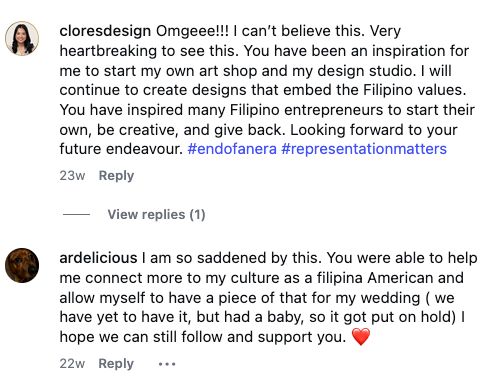
Few of the heartfelt comments we got on our Instagram
We had become a staple in the Filipino community for 10 years. We were a global 6-figure brand with customer advocates in 21 countries, a team of 8 across 2 countries, and an incredibly engaged community. So… what happened?
Well, there’s the easy answer (US tariffs), and then there’s the more nuanced, too-long-for-Instagram version.
In this article, we share the real reasons we closed and the hard won lessons along the way. We hope that if you’re a fellow founder reading this, whether you’re Filipino or not, that this post will give you honest insight into what it takes to build a business you love, that loves you back, and that embodies your values.
Tara / Ready? Let’s get to it!
Reason We Closed #1: Not Prioritizing Profit Enough.
Since our existence, Cambio & Co. was a cash-flow positive and revenue-generating business, with growth year after year. We had no debts or investors to pay back since we bootstrapped everything. It all sounded good in theory. We were even able to reinvest over $1 million dollars into our artisan partners in the Philippines in the form of sustainable livelihood!
Perhaps the most surprising part? We did this primarily through social media and organic marketing. When I tell people that we were able to scale our e-commerce brands close to 7-figures with very little paid ads, people in the industry are shocked. It’s almost unheard of for an e-commerce company. But we did it.
But our growth and high engagement online actually hid the deeper structural problems. Although we were generating revenue, we weren’t generating a lot of profit. Not enough, anyway, to make our business sustainable in the long run.
I only began taking a small salary from the business starting in 2022, and Jérôme never received a salary at all. Instead, we reinvested every dollar into buying more inventory, upgrading our tools, hiring more team members or increasing our team’s salaries. All of this at the expense of our personal lives and financial situation. Like many founders, we thought if we reinvested everything into the business, we could grow and eventually reach a scale where we turned enough profit. This never happened, unfortunately.
But it’s not all negative. This experience taught us one of the most important lessons in business; one that we’re able to share with you now.
The Hard Lesson Learned: Focus on profitability, not just revenue. And pay yourself first.
You can’t be a resource if you’re not well resourced. If you care deeply about your mission and building a business that creates more wealth for your community, then you need to be financially sustainable. And part of being sustainable means paying yourself well.
We now tell everyone we know to prioritize profit first (there’s even a book that teaches you how to do it). This doesn’t mean you have to be a soul-sucking suit who cares only about the bottom line. It does mean that profit and purpose are inseparable. It’s not a question of ‘how do you balance profit and purpose?” The better question is, “How do you grow your profit with purpose?”
Maybe the business will grow more slowly, but if it grows more profitably - and you get paid in the meantime - that will be a lot more sustainable for you, the business, and the communities you aim to serve.
Reason We Closed #2: As The Business Grew, So Did Its Complexity
As founders, our job is basically to fix problems. And with a business there is always a problem to fix, like a leaky hole in your sales funnel that could eventually capsize the whole ship.
So we get to work fixing those problems. We tell ourselves that if we just add that offer, post more on social media, or launch that cute design everyone “says” they want, then our businesses will finally be sustainable. But we end up finding patchwork solutions or hiring people to plug the holes, rather than doing what we really needed to do: rethink the foundation.
In our case, it was our decision to launch a whole second business, Sinta & Co. Filipino Weddings, in 2019.
We noticed people often bought our pieces for their wedding day, and nobody was really focusing on the Filipino wedding industry at that point. We could carry most of the same products, share inventory, infrastructure, and team members across both stores, while capturing a whole new market. It seemed like a good idea. It was a good idea. Until it wasn't.
Adding Sinta meant managing a second Shopify store, double the apps, and a second set of social media channels and marketing strategies. It was too much for our small team. Sinta did grow its own engaged following year after year, but could we have achieved that growth through a single channel through Cambio & Co.? Probably. Did we need a whole sister business? Not really.
Then there was the afternoon I got into a depressive spiral because my team and I spent a whole meeting trying to align our content creator’s work schedules with when inventory from the Philippines would arrive in Toronto, be unpacked in time by our warehouse team, and line up with the rest of our marketing calendars. The whole thing felt like a complicated juggling act and it was exhausting.
The more we scaled, the more complexity we added, and at some point the idea of growing felt more exhausting than exciting. When new opportunities came our way, Jérôme and I found ourselves grasping for reasons NOT to do something rather than the other way around. We became the roadblocks to our own growth. Looking back, this is the clearest sign that we were ready to move on.
The Hard Lesson Learned: Complexity doesn’t scale. It just gets more complex.
You can’t keep adding more elements to your business and assume it will lead to more growth. If your business right now is feeling unwieldy and complicated, chances are it’s going to continue feeling that way as you grow. It will likely get even worse.
Resist the urge to do more, post more, launch more. And instead, ask, “What would this look like if it was easy? How can I simplify? What is currently taking up more resources and energy than it’s producing?”
That usually means simplifying one of your offers or streamlining a process. It could mean letting go of an underperforming marketing channel. Or restructuring things within your team so the work feels less like a juggling act, and more like flow.
Business doesn’t have to be hard. And it definitely doesn’t need to be complicated. So where can things be easier?
Reason We Closed #3: The Business Was Moving Us Away From Our Why
Don’t get me wrong, I love Cambio & Co. and I’m incredibly proud of what we built. But at some point, it started to feel like the business was running us more than we were running it. I felt it was taking me away from my Why rather than towards it.
When we initially launched Cambio & Co. in 2015, the spirit behind it was revolution. Our name was inspired by the Spanish word ‘cambiar’ meaning ‘change’ because we wanted to change how business was done. And, as naive as it sounds, change the world. 25-year-old me wouldn’t have known it at the time, but Cambio would eventually take me on a 10+ year journey of discovering myself, my identity as a Filipina, and my purpose as an entrepreneur-activist.
I always knew that I wanted to be working directly with founders to help them grow their businesses, and it was a gift everyday to work alongside our artisan partners in the Philippines. But the day-to-day e-commerce ops and the tariffs and logistical chaos of our last year in business really took me away from the core of that work. I love meeting other entrepreneurs, but I found myself having less and less energy to do it.
Over time, a new vision began to emerge. My rallying cry became, “build ecosystems, not empires” because I believe that business can be generative rather than extractive (in fact, they MUST be). That we CAN scale our businesses in a way that creates more wealth, joy, and justice for our communities.
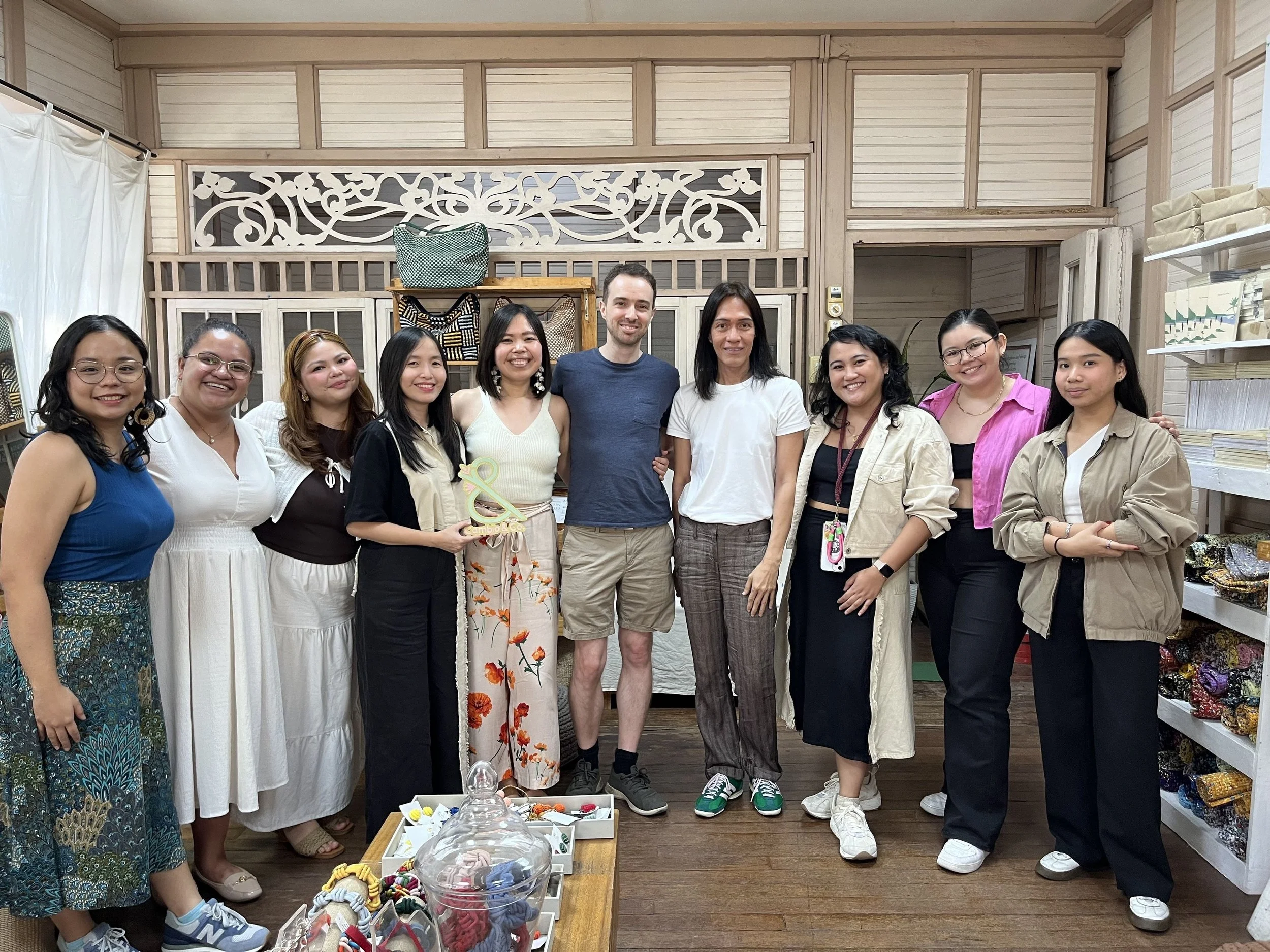
Visiting Rags2Riches team in Quezon City with our Manila Cambio team
I was already able to see the impact Cambio & Co. had with our artisan partners in the Philippines – so what if we could share what we learned with other Filipino and racialized founders? What kind of impact could we have collectively? This is a question I had wanted to explore for years, but the daily grind of running our businesses made it difficult to find the energy.
The Hard Lesson Learned: When the business stops serving your Why, it's time to re-align.
I get it. It’s hard to walk away from our businesses, especially one with a mission. We feel an obligation to keep going for our teams, customers, and partners (in our case, the artisans), especially when they’ve come to count on us as a source of livelihood and impact.
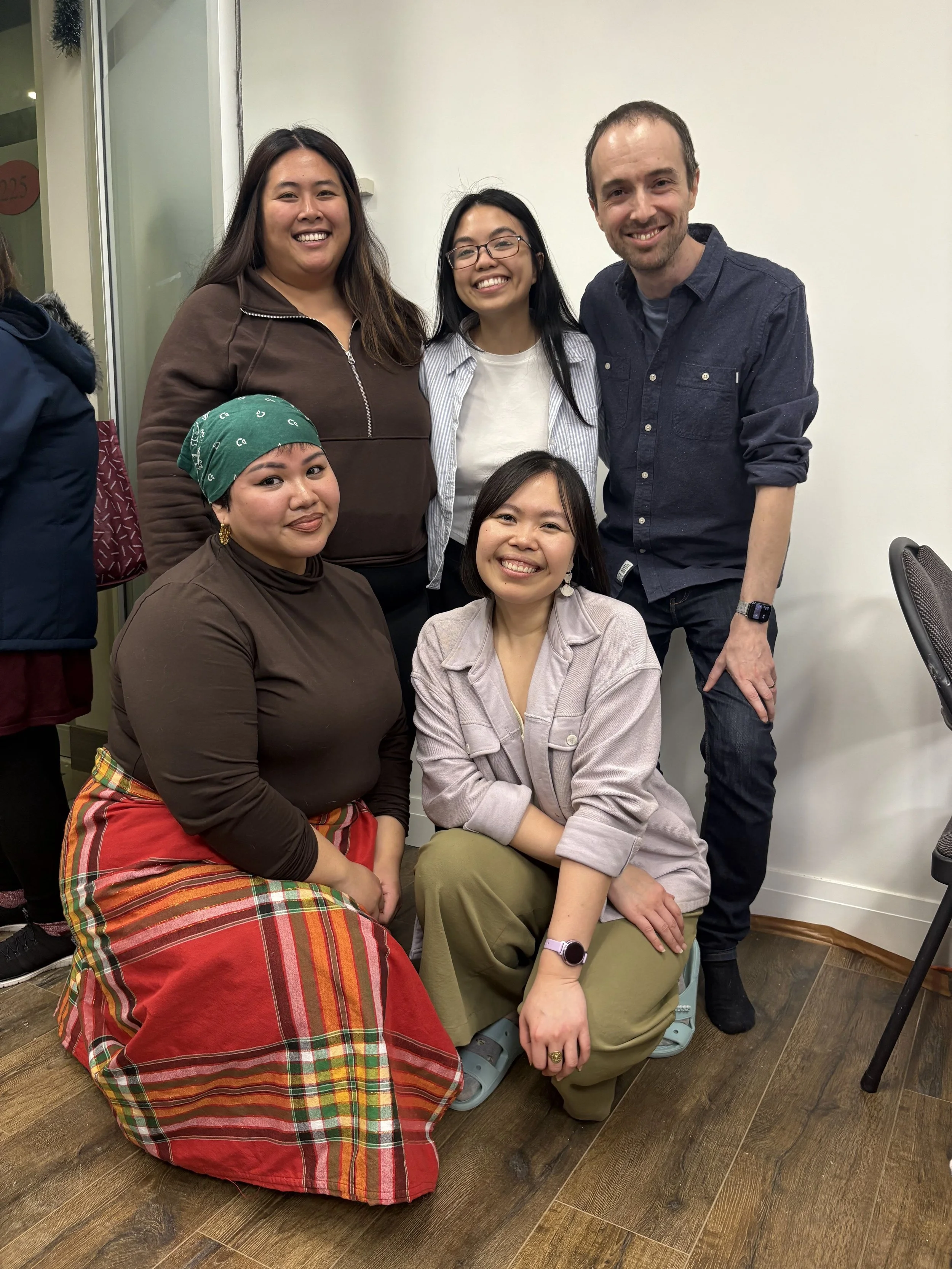
Our full Toronto Cambio team at our Good Bye party
But although we think we’re doing the righteous thing by staying on, it’s actually a disservice long-term for the people you aim to serve. And it’s certainly a disservice to you. If you're feeling resentment, burnout, or like you're constantly being pulled away from the work that actually lights you up, then these are signals begging for your attention. And it’s better to listen before you burnout for real, and then you won’t be able to help anyone. The work will stop either way. It might as well be your choice.
Though I was sad to see Cambio go, I realize now that the Universe had been asking us to re-align for years. I just didn’t want to face the truth, until something happened that made it impossible to ignore…
Reason We Closed #4: The Final Blow (US Tariffs & Rising Costs)
Although we’re a company based in Canada, 80% of our customer base was in the USA. For 10 years, we were able to operate with relative ease due to de minimis, an exemption that allowed any packages under $800 USD to enter the USA without duties or tariffs. In August 2026, the Trump administration removed the de minimis exemption, delivering a huge blow to international brands like Cambio & Co. that depended on these exemptions to be able to operate.
Things changed overnight. Suddenly packages were being turned back at the border, all the shipping companies faced long delays and confusing rules, and US customers became hesitant to shop, given everything they were reading in the media. It was chaos, and we saw our sales plummet in a span of weeks.
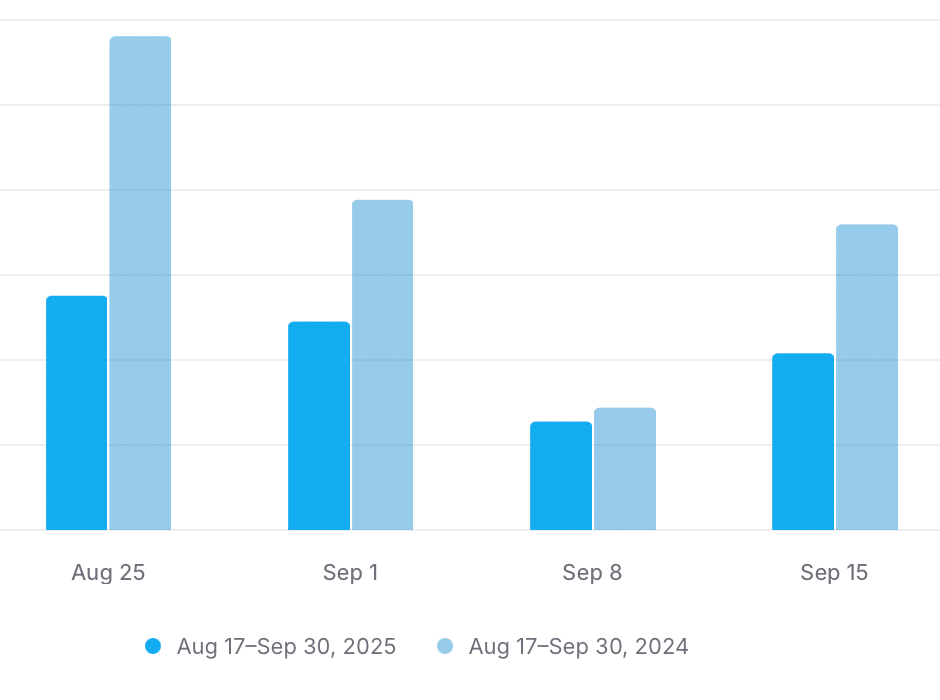
Drop in sales between 2025 and 2024
Our team did everything we could to pivot: including overhauling our operations, opening a second warehouse with a 3PL in the US, hiring a broker, and investing an incredible number of hours into learning the ins and outs of the import/export process and ever changing regulations. It was quite the nightmare and a hella stressful time.
Did it work? Yes, actually! Our sales stabilized and we were able to keep serving our community when many Canadian brands had already walked away from the US market entirely.
The bad news: our overhead was now double. We not only had to continue paying our teams’ salaries in Toronto, we were now paying rent for two warehouses and were drowning in the logistical nightmare of balancing inventory between two locations in two countries and managing the mountain of paperwork. It was A LOT for any small business to handle.
And this is where the system fails us. Less than 2% of women-owned businesses scale past 7-figures - a figure that’s even tinier when you break that down into the percent owned by racialized founders. This means a huge majority of women, BIPOC-owned, 2SLGBTQ+-owned businesses stay small - and we’re the ones that get hit hardest by harmful policies and unstable global trade.
The Hard Lesson Learned: Keep learning & always be pivoting.
As racialized founders, many of us from immigrant families, pivoting is something we know how to do. We’re adaptable and scrappy - what Filipinos call ‘diskarte’. This instinct is a strength not everyone has.
When the tariffs hit, we didn't freeze. We put up a hell of a fight, and I will always be deeply proud of that.
The pivot won't always lead where you hope. We did end up closing after all. But the knowledge you build along the way is never wasted. I’m incredibly proud of how our team responded to the challenges thrown at us, and Jérôme also discovered his superpower for maneuvering complex regulations. Now he helps other e-commerce founders navigate tariffs and cross-border operations, using so much of what we learned during that last chaotic year.
Keep investing in yourself and your knowledge. It will continue to serve you even beyond your current business.
Where We Are Today: Building Ecosystems, Not Empires 🌿✊🏽
I’m incredibly proud of what we built at Cambio & Co. The deep partnerships with artisans in my motherland, the friendships with values-aligned entrepreneurs, and the community that rallied around us. We will always owe so much to Cambio & Co., but we also owed it to ourselves to follow our larger calling.
That calling is Founding Possibilities.
We’re a growth studio designed specifically for BIPOC founders who want to scale profitable businesses that lift up the cultures and communities we come from. If you’re tired of the typical bro marketing advice and have no interest in building an empire - a business that benefits the few at the expense of the many – and instead, you want to build an ecosystem - businesses that create more wealth, joy, and justice for everyone - then we’d love to work with you!
Everything we’ve lived through, whether it’s the lows of tariffs and messy global logistics. or the highs of organic marketing wins and community-driven growth, we've poured all of it into the work we now do with purpose-driven founders like you.
If you’re navigating messy cross-border logistics and tariffs, trying to grow your audience with values-aligned marketing, or just trying to figure out what the next chapter of your business looks like, then hit us up! We’d love to see how we can support you.